

Content Confidence (How to Know a Topic Is Worth Your Audience’s Attention)
Amplify for Advisors Issue 062

A few weeks back I put up a LinkedIn post about deleting a perfectly good post the week before, because I was afraid a smarter advisor would read it and pick it apart in the comments.
I know my stuff. I have the credentials and the years behind me. And I still hovered over that button like a kid turning in a test he isn’t sure about.
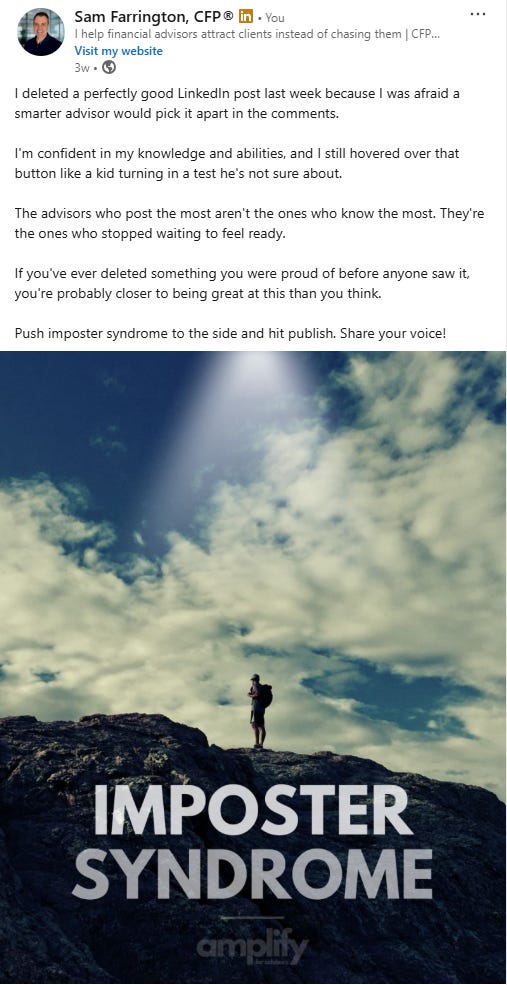
I figured a handful of people might relate. What I didn’t expect was how many.
The replies came in one after another, advisor after advisor saying they feel exactly the same way. Me too. One friend even posted a screenshot of his drafts folder, packed with posts he had written and never hit publish on.
I didn’t write that post for me. I wrote it for the advisor who has something worth saying and keeps talking themselves out of it.
You know the feeling. You draft something useful, something you have walked clients through more times than you can count, and right before you publish a voice tells you some sharper advisor is going to tear it apart. So you sit on it, or you delete it, and you go looking for something more impressive instead.
The post you talk yourself out of is usually the one another client, or even another advisor, needed to see.
You already have good instincts about this. You have just been pointing them at the wrong question.
The question is not whether the topic is impressive
When advisors get stuck on what to write, two worries are usually doing the stalling. The first is “is this valuable or is it just filler.” The second one is “am I even credible enough to say it.”
Both come from the same place. You are measuring the topic against every other advisor and every expert online, and against that crowd almost nothing feels original or worthy.
So measure it against something smaller and more useful instead. Measure it against one real person you serve.
A topic is worth your audience’s attention when one actual client would have asked you about it. Not the whole internet (and especially not other advisors).
One person who would have leaned forward and said “wait, can you explain that again.” If you can picture that person, the topic is worth sharing. If you can’t picture anyone in particular caring, that is your answer too, and it cost you thirty seconds instead of an hour.
That is the whole test. It is simpler than the version running in your head.
Credible enough is closer than you think
The credibility worry is the one I want to take the air out of, because it stops good advisors from sharing their voice.
You do not need to be the most knowledgeable person on the topic. You need to be one step ahead of the person reading. When I started my RIA I had zero clients and no audience, and the people who helped me most were not the big dawgs (yes dawgs with a ‘w’) in the industry. They were the advisors a year or two further up the trail who still remembered the climb and inspired me to get there.
That is the role your content plays. You are not lecturing from the summit. You are turning around on the path and telling the person behind you what is coming.
And the proof that you can write about something is not a credential. It is the part only you can add. A generic article can define an idea. But it cannot tell the reader what actually happened the last time you walked a family through it, or the small detail you have learned to watch for that the textbook skips. That part is yours, and it is the part that earns trust.
So before you spend a morning on a piece, it helps to pressure-test the topic against your specific niche first, fast, and before you are emotionally invested in it.
That is what the prompt below does.
The Topic Confidence Check
You are my content strategist. I am a financial advisor deciding whether a
topic is worth writing about before I spend time on it.

MY NICHE:
[Describe your ideal client in one or two sentences. Example: pre-retirees in
their late 50s who worry about running out of money.]

MY TOPIC IDEA:
[Write the topic exactly as it is in your head, even if it feels too basic or
half-formed.]

WHAT I WANT YOU TO DO:
1. Tell me whether this topic is signal or noise for MY specific audience, and
   why. Be honest if it is too broad to matter to them.
2. Name the one real question a person in my niche is actually asking
   underneath this topic.
3. Give me three sharper angles on it that only someone who works with my niche
   could write.
4. Tell me what I could add from experience that a generic article cannot.
5. If the topic is weak, suggest a stronger adjacent topic my audience would
   care more about.

TONE:
Practical and direct. Talk to me like a colleague, not a hype machine.

COMPLIANCE GUARDRAILS:
- Frame everything as education and perspective, not specific advice. Use
  "I believe," "in my experience," and "you might consider," never "you should"
  or "you must."
- Do not promise or imply any outcome, performance, or result.
- Keep all examples general. Never include real client names or identifying
  details.
- Flag anything in my topic that would need a disclaimer or compliance review
  before publishing.
- When in doubt, keep it educational.
Run a topic you have been second-guessing through it. You will know pretty quickly whether to write it, sharpen it, or set it down.
The thing you almost skipped is usually the thing someone needed to hear.

Sam Farrington, CFP® | Creator of Amplify for Advisors
P.S. Issue 61 was about using AI to reclaim time instead of just producing more of everything. If it gave you back even twenty minutes this week, spend ten of them dropping one shaky topic idea into the prompt above. That is the fastest way I know to turn reclaimed time into something your audience will actually read.
New to Amplify for Advisors?
Issue 4, The R.O.I. Filter. For deciding what is worth creating before you start.
Issue 38, The Pain Point Solutions Matrix. For mapping the questions your audience is already asking.
Issue 7, But I’m Not a Writer. For the quiet voice that says you are not credible enough yet.
Explore more at amplifyforadvisors.ai.